Insect Habitats: Traceable Design Knowledge
Organising design statements, decisions, and supporting information from a youth co-design project.
Work in progress · AI-assisted mapping · Human review planned
2026 · Digital Common(s)
AI-Assisted Text Analysis · Decision Mapping · Evidence Tracing
I. OVERVIEW
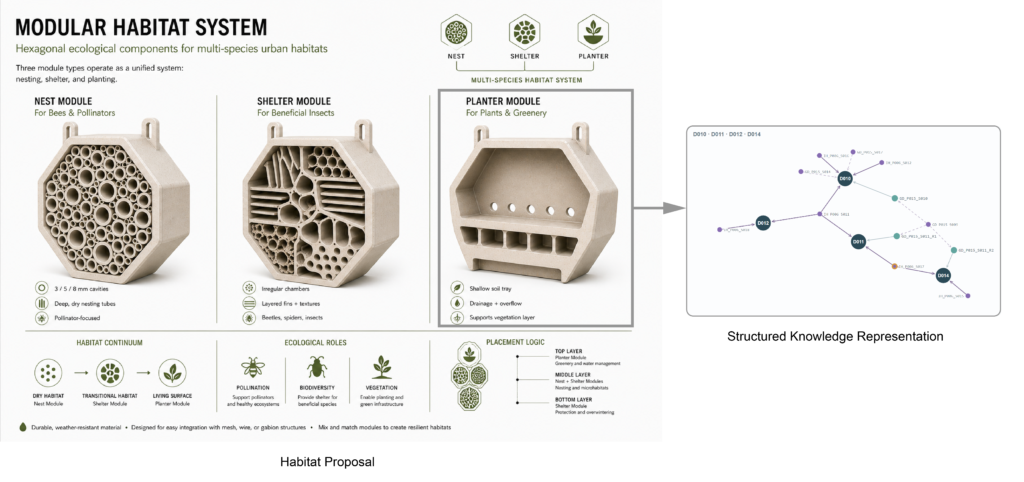
This research investigates how design documentation can be organised into structured, reusable knowledge while preserving connections to its original evidence. The case study is a youth co-design project exploring biodegradable insect-habitat proposals for Sai Sha, Hong Kong.
Design knowledge is distributed across drawings, annotations, and presentation pages. A feature may appear in several documents, while its intended purpose is explained elsewhere. Similar descriptions may refer to different choices, and differently worded statements may describe the same feature. Organising this material requires attention to the component, property, context, and source of each statement.
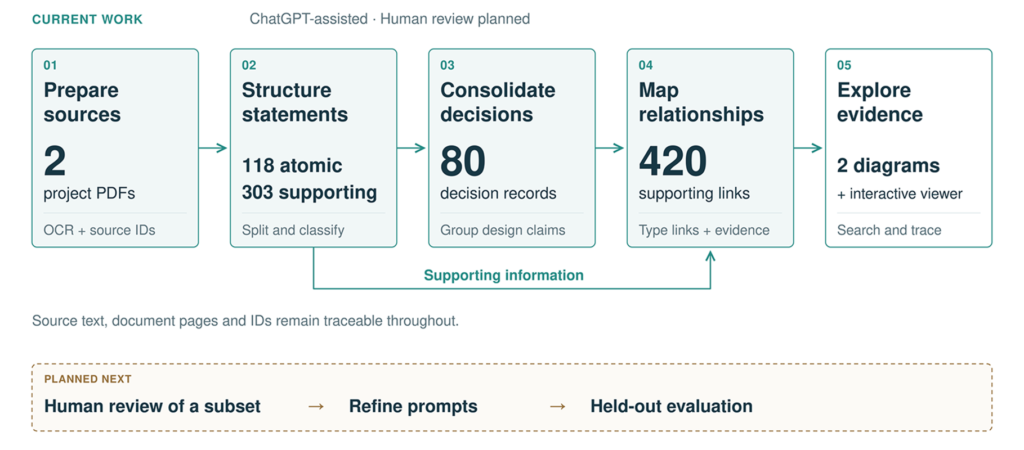
The current work uses ChatGPT (Sol) to help structure this information into design statements, decision records, and supporting relationships. Two network diagrams and an interactive viewer make these records available for inspection. The resulting dataset provides a basis for subsequent human review and evaluation of the extraction and mapping process.
II. METHODOLOGY
The workflow begins with two project PDFs. Text extraction and optical character recognition (OCR) prepare the source material for analysis, while document names, page references, and source wording are retained.
ChatGPT then assists with three tasks: structuring statements, consolidating descriptions of the same design choice, and mapping supporting information to relevant statements or decision records. The resulting records distinguish what the documents describe, what they claim, and how connections have been interpreted.
Source references remain available throughout the workflow. Unassigned statements and unlinked information are retained for review rather than removed from the dataset.
III. FROM STATEMENTS TO DESIGN RECORDS
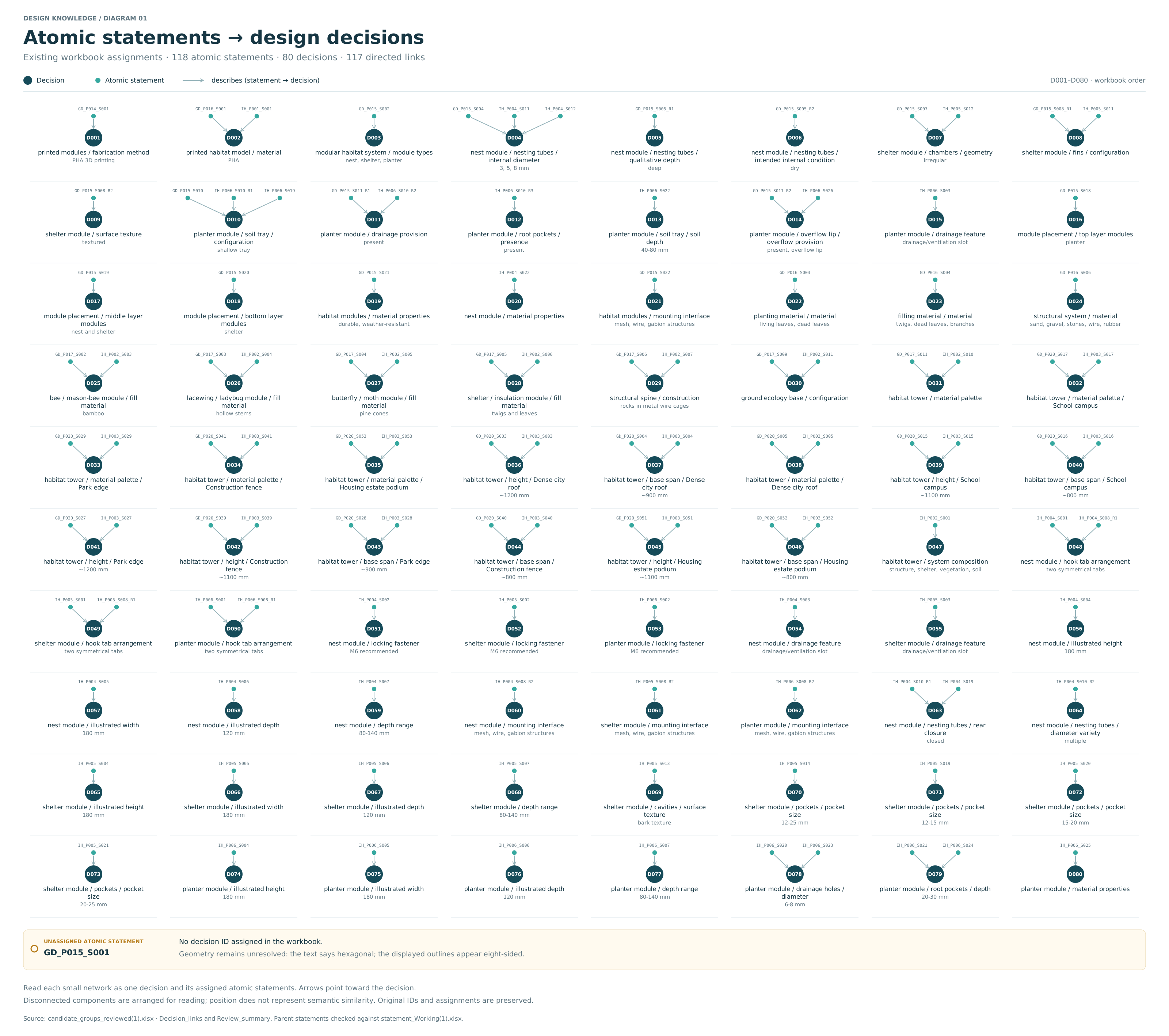
The first representation contains 118 atomic design statements. Each statement expresses a single design claim, with fields for its component, property, value, unit, and scope where applicable.
Atomisation separates features that appear together in a sentence but describe different design choices. For example, a description of drainage and overflow in the planter module is separated into statements about drainage provision and overflow provision. This allows each feature to be examined independently while retaining its source context.
Statements describing the same design choice are then consolidated into 80 decision records. These records represent choices documented in the source material; they do not reconstruct the designers’ complete reasoning or decision history. The current mapping contains 117 statement-to-decision assignments, with one statement remaining unassigned.
IV. SUPPORTING KNOWLEDGE AND INTERACTIVE VIEWER
The second representation organises 303 supporting statements, including contextual observations, design intentions, claimed benefits, and proposed actions. The current mapping contains 420 relationships, connecting 219 supporting statements to relevant design statements or decision records. The remaining 84 statements are retained without assigned targets.
For example, the planter module’s drainage and overflow provisions are recorded as separate design choices, while a supporting statement describes their combined role in preventing water buildup. The viewer connects this joint claim to both features and their source references, allowing readers to inspect the documented rationale without treating it as verified performance.
The interactive viewer allows users to search and select records, focus on their connections, and inspect relationship types, source text, page references, and identifiers. Unlinked statements can also be displayed. These functions support examination of how the documentation has been interpreted and where each connection draws its evidence.
V. CURRENT CONTRIBUTION AND NEXT STEPS
The current contribution is a structured representation of a design case, supported by the network diagrams and an interactive viewer. It distinguishes individual source statements, consolidated design choices, and supporting information while preserving links between them. These outputs remain provisional. Their completeness and correctness have not yet been established through independent human evaluation. Claims about ecological benefits, material behaviour, or design performance are recorded as claims from the project documents.
The next stage will examine whether partial human review can improve ChatGPT-assisted extraction and mapping. Reviewers will correct a selected subset of statements, decision assignments, and relationships. Their judgments will inform a revised coding guide and examples supplied in subsequent prompts. This approach adapts the prompting context while keeping model parameters unchanged.
CREDITS:
Insect Hotel Project Teaching Context: The Insect Hotel project is a part of the teaching deliverables of Contextual Intelligence workshop held by Digital Common(s). The project is taught by Jing Chang as the tutor, assisted by Hollis Hui as the Teaching Student Leader. Students are Tony Kam, Haden Yau, Kailin Huang.
Research Works: Individual
Proposed Paper Authors: Jing Chang, Hollis Hui, Carson Leung, Felix Leung, and Provides Ng.